Business
The Rise of Circular Economy Business Models: Turning Sustainability into Profit
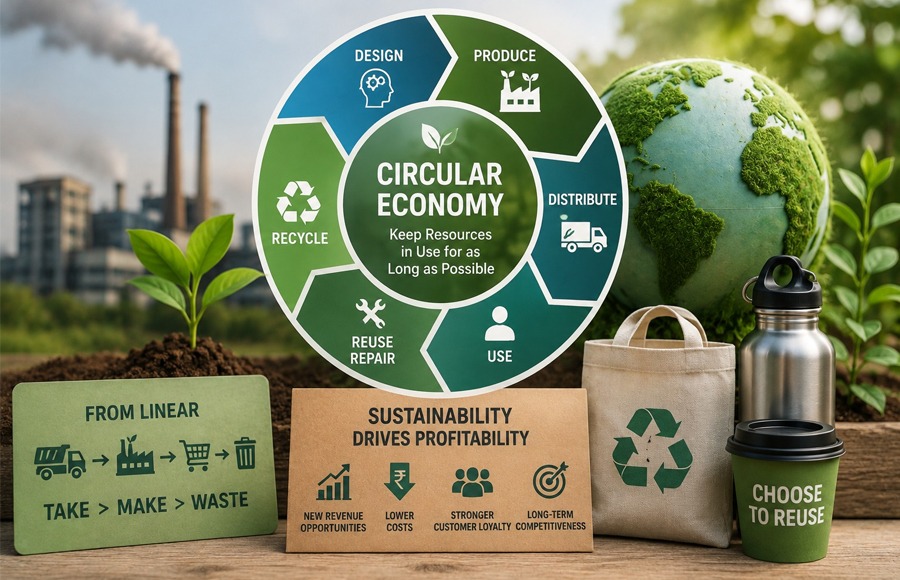

For years, many companies have followed a straightforward business model; produce, consume and dispose of. In a traditional linear model, you take a finite natural resource, build something with it, and sell it, and then it ends up as waste. Though our society can point to economic gains achieved through this process, it’s also responsible for a considerable amount of environmental damage, including depletion and waste.
This problem is one of the reasons the circular economy model designed to keep products and materials in use for the longest period possible has recently garnered considerable attention.
Many of the ways in which you approach designing products, managing natural resources and deriving value from them are altered with circular models. That said, organizations are also finding out that circular actions can make money, lower costs, encourage customers and give them a long-term advantage.
What Is a Circular Economy?
A circular economy is an economic system designed to minimize waste and maximize the continued use of resources. Instead of producing goods that are eventually discarded, businesses aim to repair, reuse, refurbish, remanufacture, or recycle products and materials.
The circular economy is based on several important principles:
- Reduce unnecessary resource consumption
- Design products for longer lifespans
- Reuse products and materials
- Repair and refurbish goods
- Recycle valuable resources
- Minimize waste
- Create sustainable value
Businesses are thus capable of transitioning from the linear economy-called, take, make, lose-and more to a closed-loop economy where production resources are not wasted but stay useful in time.
Why Businesses Are Adopting Circular Models
Increased resource costs, changing customer perceptions, environmental legislations and enhanced competitive pressures are key drivers for adopting circular business models.
More efficient utilization of resources can lower production costs. For the businesses the repair and refurbishment of products can add to profit centres while recycling of scarce materials can minimize over-reliance on fresh extraction.
The consumer interest in sustainable products and green businesses is on the rise and this creates opportunities for businesses to capture new markets and gain competitive advantage.
Product-as-a-Service Business Models
One of the most interesting circular economy models is product-as-a-service.
Instead of selling a product permanently, companies provide customers with access to it through rental, subscription, or leasing arrangements.
For example, rather than purchasing expensive equipment, a customer may pay a monthly fee to use it.
This model creates several benefits:
- Recurring revenue
- Longer customer relationships
- Better product utilization
- Greater control over product maintenance
- Easier product recovery at the end of its useful life
Because companies retain ownership of products, they have a stronger incentive to design durable and repairable goods.
Repair and Refurbishment
Used goods can be recovered rather than thrown away-they are repaired and refurnished and become valuable goods.
Companies can take back used products, fix what is broken, improve technology if needed and then sell it at an attractive price again.
This approach creates opportunities in industries such as:
- Electronics
- Automobiles
- Furniture
- Appliances
- Industrial equipment
- Fashion
Refurbished products can appeal to budget-conscious buyers and reduce the environmental implications of manufacturing a new product.
Resale and Second-Hand Markets
With greater consumer confidence, the resale economy has exploded in recent years.
Everywhere-from fashion and electronics to furniture and cars, many product categories boast thriving secondary markets. And companies can tap in by either establishing a reselling platform themselves, or working with resale partners or markets. The resale of used items can create an extra source of revenue, while prolonging the life of products and creating opportunities to connect with a new base of customers who are not willing to buy directly at a full price new cost point.
Recycling as a Business Opportunity
The Role of Recycling. Is a key enabler of circular business models. By using the collection of used goods, they might make it possible to retrieve from those materials of interest in them.
There may be valuable recovered materials.
For example metals plastics papers and electronics glass can potentially recover material. It’s in this way companies could achieve a materials cost reduction with a recycling business. Of course recycling in combination is better with other activities such as reuse and repairs design improvement.
Designing Products for Circularity
Circular economy success begins at the product-design stage.
Businesses can design products that are:
- Durable
- Repairable
- Modular
- Upgradeable
- Recyclable
- Easy to disassemble
A product designed for a longer life can reduce waste and strengthen customer satisfaction.
Companies can also sell repair parts and offer repair services in so doing creating new points of contact and continued interaction with their customers.
Real-Life Example: IKEA
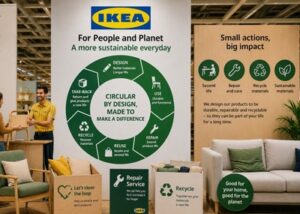
For an example of a large retailer looking at how circular economy practices can support business models, we see IKEA. It has been looking into initiatives on the resale, take-back, repair, and recycling of furniture and also looks into the use of more sustainable materials.
One key idea here is to prolong the life span of the products but also gives opportunity to interact with customer further than the purchase date. Overall, it does seem like customers can consider sustainability as a part of both their and the companies customer experience and business model not an isolated activity.
How Circular Models Can Increase Profitability
Sustainability and profitability do not necessarily have to conflict.
Circular business models can improve financial performance through several channels.
- Lower material costs: By recycling the extracted materials it is possible to lessen the reliance on expensive raw materials.
- Recurring revenue: A rental and leasing, or subscription-based business model. Can create a more predictable revenue stream.
- New revenue streams: Repair, refurbishment, resale, and recycling can create additional sources of revenue.
- Customer loyalty: Environmental actions can help build a rapport with environmentally aware customers.
- Reduced waste: A more efficient use of your resources can also lead to decreased operating and disposal costs. Used collectively, such a combined strategy may serve as the best foundation for establishing even greater viability and robustness into your existing operations.
Challenges of the Circular Economy
Despite its potential, transitioning to a circular business model is not always easy.
The companies might want to redesign the products, reorganize supply chains, invests in logistics return; put up collection system, and organize for customer education.
Other challenges include:
- High initial investment
- Complex logistics
- Product-return management
- Quality control for refurbished goods
- Changing consumer habits
- Limited recycling infrastructure
What you need is a long-term strategic imperative and not simply use this as a superficial marketing exercise.
The Future of Circular Business
Technology is expected to be crucial in fast-tracking the circular economy. Smart use of AI, data analytics, digital product passports, automation and new recycling methods will allow business to know where their products are, predict demand and manage stock, while recovering useful material. As sustainability rules become stronger and consumer demand for transparency rises, the circular business model will surely increase in relevance across sectors, and those companies that move quickly will risk having a competitive advantage.
Conclusion
The advent and proliferation of circular economy business models highlight the truth that sustainability can be a catalyst for innovation and profit. Products with extended life-cycles, waste reduction and re-use, and new income streams all translate into better environmental outcomes as well as better business performance.
In the future we will see an increasing emphasis on linking together economic value and efficiency of resource use, and businesses that make this leap will have the ability to construct successful, responsive and sustained entities for their own benefits and for the benefit of society.
Tags
Related Posts


Real Estate
Why Transit-Oriented Development Could Change How Indians Choose Their Next Home
Why Transit-Oriented Development Could Change How Indians Choose Their Next Home What…

Lifestyle
Why Your Sleep Schedule Matters More Than You Think: Understanding the Body Clock
You can sleep for eight hours and still wake up feeling exhausted.…

Finance
What Is a Credit Score Really Made Of? Understanding the Factors That Affect Your CIBIL Score
What affects your CIBIL Score, and how can you improve it? CIBIL…