Finance
The Success of Avenue Supermarts DMart : Financial Lessons from India’s Retail Giant


India’s retail market has exploded in the last two decades, spurred by the increase in income, urbanization, and shifting customer preferences. Among a variety of success stories that emerged from this space, one that has particularly impressed investors and customers is that of Avenue Supermarts Limited, also popularly known as DMart. Started in 2002 by ace investor Radhakishan Damani, DMart has cemented its name as one of the most well loved retailers in India known for delivering value in the form of quality goods at low prices and with incredible financial discipline.
The success of DMart also lies in its conscious decision to take the path less traveled in an industry known for its swift expansions and heavy marketing.
Instead of aggressive growth and spending on branding, the company focused on building a customer centric and cost conscious approach that has helped it achieve sustained profitability over the years, turning it into one of India’s most successful retail stocks. This DMart story offers plenty of lessons to learn in the world of finance for all aspiring entrepreneurs, investors and leaders.
The Beginning of DMart
DMart opened its first store in Powai, Mumbai, in 2002 with a simple mission, to provide everyday products at the lowest possible prices without compromising quality.
The company focused on essential household products such as:
- Groceries
- Packaged foods
- Personal care items
- Home essentials
- Kitchen products
- Clothing
Instead of focusing on luxury segment, DMart concentrated more on the middle class families looking for quality and affordability.
This customer first philosophy became the foundation of its long term success.
A Unique Business Model
One of DMart’s biggest strengths is its simple yet highly effective business model.
Unlike many retailers that rely on expensive store interiors and promotional campaigns, DMart focuses on operational efficiency.
Its strategy includes:
- Low operating costs
- Limited product assortment
- High inventory turnover
- Everyday low pricing
- Efficient supply chain management
The company passes the savings from unnecessary expenses on to you, the customer.
Customers have learned over time to develop this habit of following these practices.
Owning Stores Instead of Renting
A major reason behind DMart’s financial strength is its preference for owning store properties rather than leasing them.
Although purchasing property requires higher initial investment, it provides several long term benefits:
- Lower rental expenses
- Stable operating costs
- Asset appreciation
- Greater business control
The owned assets add considerable value to the firm’s balance sheet as the assets will increase their market value with the passage of time.
That long term outlook points to careful and responsible financial planning.
Efficient Inventory Management
Inventory management plays a critical role in retail profitability.
DMart maintains fast inventory turnover by stocking products that customers purchase frequently.
The company carefully manages:
- Product demand
- Stock levels
- Supplier relationships
- Warehouse operations
Fast moving inventory reduces storage costs and minimizes waste.
Good inventory control helps enhance your cash flow, which leads to a higher profit margin.
This operational excellence is one of DMart’s key competitive advantages.
Focus on Cost Control
DMart has built its success through strict cost discipline.
The company avoids unnecessary spending on:
- Lavish store designs
- Heavy advertising
- Excessive operational expenses
- Instead, it invests in:
- Supply chain efficiency
- Customer satisfaction
- Inventory optimization
Dmart makes lower costs by providing goods at affordable costs. But their margins remained in excellent position.
It shows that controlling your costs is often as vital as boosting sales.
Customer Centric Approach
Customer trust has been central to DMart’s growth.
The company consistently delivers:
- Affordable prices
- Reliable product quality
- Convenient shopping experience
- Availability of essential goods
Forget temporary promotional schemes; in DMart, the focus is always on offering value, day in, day out.
Satisfied customers return frequently, creating repeat business and stable revenue.
This client base also happens to be one of its largest assets.
Strong Financial Performance
Since its stock market listing in 2017, DMart has attracted significant attention from investors.
The company’s consistent growth has been supported by:
- Rising revenues
- Healthy profit margins
- Strong cash generation
- Efficient capital allocation
- Conservative financial management
Unlike businesses that depend heavily on debt, DMart has maintained a financially disciplined approach.
Its stable financial performance has earned investor confidence over the years.
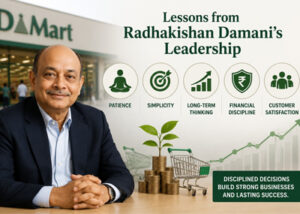
Lessons from Radhakishan Damani’s Leadership
Founder Radhakishan Damani, one of India’s most respected investors, has played a significant role in DMart’s success.
His business philosophy emphasizes:
- Patience
- Simplicity
- Long term thin Customer satisfaction
Damani’s strategy for expansion, however, was about sustainable, gradual growth, not an immediate boom.
This leader also shows that steady and prudent decision making can lead to much better outcomes in the long run than an ambitious expansion drive.
Challenges Facing Modern Retail
Despite its success, DMart operates in a highly competitive retail environment.
Key challenges include:
- Growing e commerce competition
- Changing consumer preferences
- Inflation affecting purchasing power
- Rising logistics costs
- Expansion into new markets
In order to be competitive, the firm keeps on the track of bettering operational efficiencies and yet adapting to customer needs.
It will go a long way to determine if it can sustain growth along with its spending discipline.
- Financial Lessons from DMart: The success of DMart offers several valuable financial lessons
- Focus on Long Term Value: Usually, steady progress can give a better outcome than quick growth.
- Control Costs Carefully: Reducing unnecessary expenses improves profitability.
- Customer Satisfaction Drives Success: If a customer continually gets value out of what you sell or do for them, then they are likely to become a loyal customer.
- Own Quality Assets: Strategic investments in assets over long terms create financial stability.
- Financial Discipline Matters: Strong cash flows and disciplined capital allocation result in enduring business prosperity.
Conclusion
The Avenue Supermarts story, in conclusion, shows us that it is not through a heady mix of extravagant spending and relentless growth but by dint of financial discipline, operational prowess and a singular focus on the customer that lasting shareholder value can be created. DMart, as we have all seen over the years, has achieved this through the mantra of affordability, efficiency and a customer first approach. For investors, entrepreneurs and entrepreneurs across the country, Avenue Supermarts remains an excellent template for what patience and careful planning in financial and business management can achieve over the long haul.
Tags
Related Posts




Finance
SIP vs Lump Sum: How Do These Two Investment Approaches Differ?
Investing is not just about choosing the right mutual fund. It is…

Health
Screen Time and Your Eyes: What Long Hours on Devices Can Really Do to Your Eyes
From checking emails and attending online meetings to scrolling through social media,…

Sports
How Sports Leagues Are Creating New Career Opportunities Beyond Athletes
Sports leagues are no longer defined solely by the athletes competing on…