Business
How Corporate Governance Strengthens Business Performance and Investor Confidence
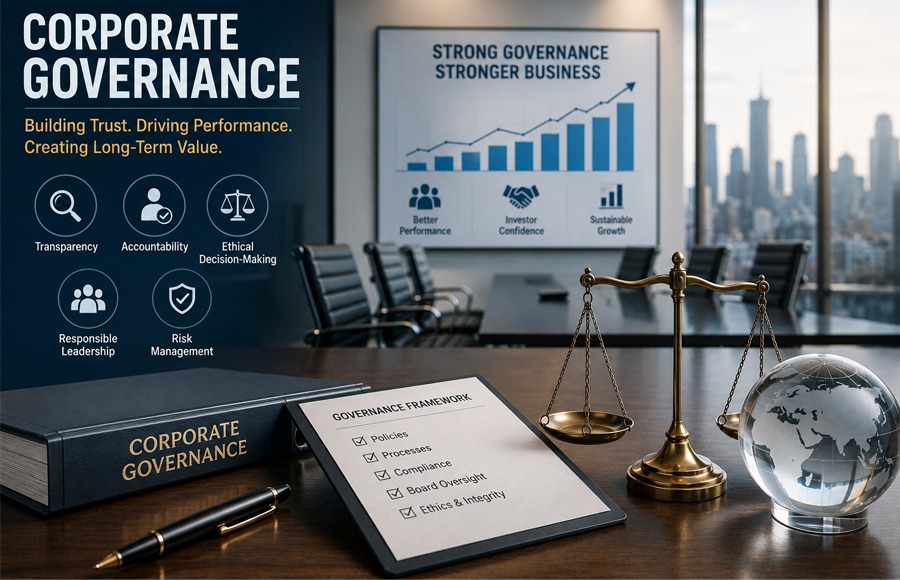

Corporate Governance, an essential pillar for successful businesses corporate governance involves policies and procedures that all people inside a company including senior manager, executives, the board of directors, and the employees must follow when they are conducting business and other relevant work for the company as defined by their roles and responsibilities. A company with good corporate governance will generally reflect its performance positively and it enhances the likelihood that it will not only continue to perform well in the future, but also that it may be less exposed to risk. In today’s volatile, highly regulated business world where investors and partners care a lot more about responsible and unethical behaviour, more focus is put into the corporate governance policies of businesses.
A strong corporate governance reputation creates more value and trust, a favorable image and can increase accessibility to and reduce the cost of capital.
This article will take a deeper look at how these policies improve overall business performance and investor trust.
What Is Corporate Governance?
Corporate governance refers to how a company is directed and controlled. It’s describing what are the duties between shareholders; directors; the CEO Manager; the staff members; costumers as well as a regulators and everybody you might be within one kind of company structure with your corporation.
Good corporate governance ensures that business decisions are made fairly, ethically, and transparently.
The key principles of corporate governance include:
- Accountability
- Transparency
- Fairness
- Responsibility
- Ethical leadership
- Risk management
When these principles are consistently followed, businesses create a stable environment for sustainable growth.
Promoting Ethical Leadership
The importance of a leader in good governance A leader can serve as the ethical standard for the entire company. The choices they make impact everyone. This doesn’t necessarily exclude profitability altogether, but it does mean balancing business success with moral uprightness, always operating within the confines of law and exhibiting a genuine desire to do the right thing.
Strong ethical leadership helps businesses:
- Build trust with stakeholders
- Reduce misconduct
- Improve employee morale
- Strengthen company culture
- Protect long term reputation
When employees observe ethical leadership at the top, they are more likely to follow the same standards in their daily work.
Improving Transparency
Transparency is essential for maintaining investor confidence.
Companies should provide accurate and timely information regarding:
- Financial performance
- Business strategy
- Corporate risks
- Executive compensation
- Governance practices
- Regulatory compliance
Transparent reporting allows investors to make informed decisions.
Organizations with a willingness to show the results of their successes and failures appear to be better regarded by the financial markets.
Transparency also reduces uncertainty and strengthens public trust.
Strengthening Accountability
Corporate governance clearly defines responsibilities across the organization.
Executives are responsible for business results but have a duty to meet the objectives responsibly, while the directors of the company supervise.
Accountability helps ensure:
- Better decision making
- Stronger financial discipline
- Reduced misuse of company resources
- Effective oversight
- Continuous performance evaluation
Organizations with clear accountability structures often respond more effectively to challenges and opportunities.
Enhancing Risk Management
Every business faces risks, including financial, operational, legal, technological, and reputational risks.
Strong corporate governance encourages proactive risk identification and management.
Businesses establish systems to:
- Monitor business risks
- Strengthen internal controls
- Ensure regulatory compliance
- Protect sensitive information
- Prepare for unexpected disruptions
Good risk management not only reduce potential financial or other material loss but also build up organisation capabilities which allow effective recovery.
Responsible use of risk management techniques. Most investors favor the company that shows some caution regarding the uses of risk management techniques.

Building Investor Confidence
Investor confidence is one of the greatest benefits of strong corporate governance.
Investors are more likely to support companies that demonstrate:
- Honest reporting
- Responsible leadership
- Sound financial controls
- Independent oversight
- Long-term strategic planning
When investors put their confidence in management, it makes them more apt to give cash and put it there a while longer
Businesses enjoy greater stability and long term profitability on the back of solid investor confidence.
Improving Financial Performance
Although corporate governance is not solely focused on profits, it often contributes to stronger financial performance.
Good governance improves business efficiency by encouraging:
- Better resource allocation
- Strategic planning
- Effective monitoring
- Responsible investment decisions
- Cost control
Doing so will increase efficiency in how your business works and, will prevent unnecessary risks.
Companies that are better managed are usually more successful over the long-term.
Strengthening Board Effectiveness
The board of directors plays a vital role in corporate governance.
An excellent board, by definition, offer independent scrutiny and strategic leadership with sound judgment.
Strong boards typically:
- Monitor executive performance
- Review business strategy
- Approve major investments
- Oversee risk management
- Protect shareholder interests
A diverse and experienced board contributes to balanced decision-making and long-term success.
Supporting Sustainable Business Growth
Corporate governance encourages businesses to focus on sustainable growth rather than short term profits.
Responsible governance considers the interests of:
- Shareholders
- Employees
- Customers
- Suppliers
- Communities
- Regulators
When you’re able to get both needs in alignment, it helps you foster strong relationships and set your business up for sustained success.
Additionally, good governance can help enhance resiliency when facing the challenges associated with unpredictable financial situations.
Protecting Business Reputation
A company’s reputation is one of its most valuable assets.
Strong corporate governance helps protect reputation by promoting:
- Ethical conduct
- Legal compliance
- Fair business practices
- Transparent communication
- Responsible leadership
Positive impressions of a business usually serve to draw in customers, employees, and investors who remain with you in the long run.
Conversely, poor governance practices can result in loss of capital, legal penalties, and a marred reputation in the eyes of the public.
Real Life Example: Tata Group
Here is another prominent example that is considered a textbook one for strong corporate governance in India, Tata Group. The conglomerate’s reputation over the years for ethical practices, social accountability, transparency and focus on long term shareholder value creation is widely admired globally. A stringent approach to its governance principles has indeed been one key pillar for its sustained business growth, strong investor confidence and public trust on the group’s practices. This approach has been integral for not only shareholders, customers and employees, but also key regulators.
Best Practices for Strong Corporate Governance
Businesses can strengthen governance by:
- Establishing an independent board of directors
- Maintaining transparent financial reporting
- Following ethical business practices
- Strengthening internal controls
- Conducting regular audits
- Managing risks proactively
- Encouraging accountability
- Complying with legal and regulatory requirements
To stay one step ahead and relevant to stakeholders your business will find it extremely useful to consistently build better governance frameworks over time.
Conclusion
Beyond Simply Being Regulated For the business world, however, corporate governance is an invaluable tool for improving business performance, promoting efficiency, and winning over investors. Excellent corporate governance systems enable businesses to cultivate an environment that offers Transparency, Accountability, Ethical Executive Leadership, and effective management of risks.
In our continually competitive and ever changing modern business world companies with effective business governance are more equipped to gain investments, risk mitigation, reputation management and success over the span of many years, not just at the current present time. There is benefit to be gain for all from business having solid governance practices not just for its Investors but its workforce, Customers and local Communities in general.
Tags
Related Posts




Sports
How IPL Data Analytics Is Changing the Way Indian Cricket Teams Build Winning Strategies
Within cricket, the Indian Premier League is arguably one of the world’s…

Food
Traditional Italian Breakfast Foods and the Culture Behind Them
World-famous is Italian food of course, especially the pasta, pizza, risotto and…

Real Estate
The Rise of Senior Living Communities in India: A New Real Estate Opportunity for 2027
The real estate market in India has entered an era where new-age…