Sports
How IPL Data Analytics Is Changing the Way Indian Cricket Teams Build Winning Strategies
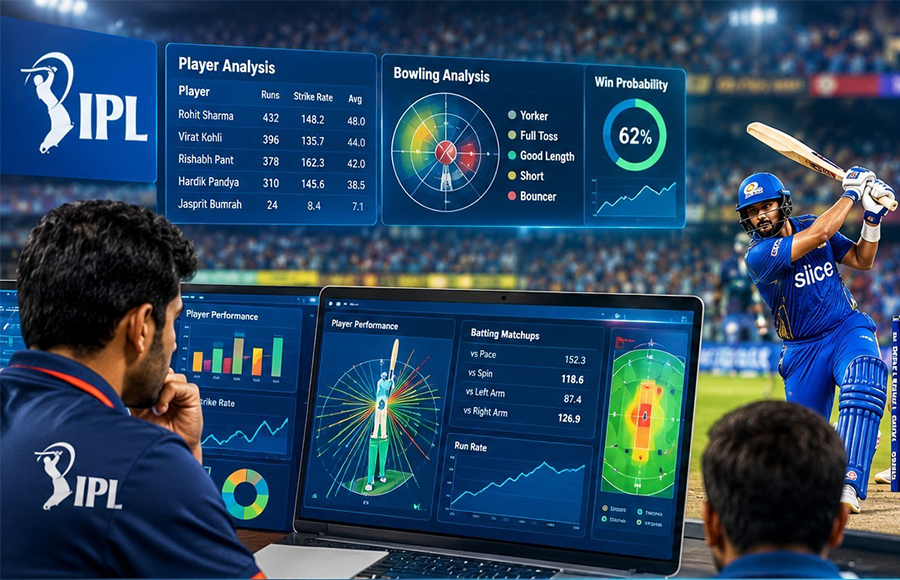

Within cricket, the Indian Premier League is arguably one of the world’s most cutthroat professional sporting arena. While expertise and intuition still hold key value to both batting line-up and bowling strategy, teams now largely rely on data to facilitate and strengthen all their decisions prior and even during a match. From choices pertaining to team selections and auction preparations, to developing certain batting line-ups and defining bowling line-up strategies, data analysis now stands as a core component of modern IPL cricket.
The collection of vast quantities of data now centres around the player, the opponent, the conditions, the context and even the performance of both the participants themselves. Coaches and analysts now glean through the said information with a view of finding patterns which may not otherwise come evident from plain, everyday observation, thereby paving the way for more scientific ways of building a team and winning the game.
What Is Data Analytics in Cricket?
Cricket data analytics involves collecting and studying numerical information from matches and training sessions. Traditional statistics such as runs, wickets, batting averages, and economy rates remain useful, but modern analytics goes much further.
Teams can examine strike rates against particular types of bowling, scoring patterns in different overs, boundary percentages, dot-ball rates, wagon wheels, bowling lengths, and performance under specific match conditions.
For example, a batter may have an excellent overall strike rate but struggle against left-arm pace during the first six overs. Analysts can identify this pattern and help the coaching staff develop a specific strategy around it.
Smarter Player Selection
The primary advantage of analytics is better player identification. Since IPL franchises require both well-rounded teams as well as be bound by financial and strategic constraints.
Data can assist teams in evaluating players under different conditions and roles, so a team may need to think beyond past reputation or flashy stats to assess a player’s contributions on the field in various situations such as their consistency over match-ups against opponents, value of their fielding efforts, availability based on previous injuries and value under different match scenarios.
This is especially useful in the IPL auction, when franchise teams are vying to acquire limited player talent and may identify underestimated players through analytical models, suited to a team’s strategic planning.
Auction Strategy and Team Building
IPL auctions are an excellent illustration of how to use data-driven decision making. The challenge facing franchises is what player they want, how much to spend on them, and which positions to invest significantly on. For instance, a franchise might realize that death bowling is weak in their attack, thus the team would focus on bowlers with good death over stats – ideally, those with high economy rates and high average over overs 16-20.
A team could be in search of a middle-order bat where the strategy could involve looking for batsmen who have high strike rates against spin, good chaser numbers and can hit boundaries under pressure. In that sense, an analysis can narrow a general scouting exercise to a more specific exercise.
Understanding Batting Matchups
Today teams take batting and bowling matchups seriously, the analysis part. There is work of analysing that specific batsmen’s record against that specific type of bowler, e.g., if a batsmen do not play leg spin well especially quality leg spinner. At some crucial stage one can try to bowl a spinner to a batsman.
Also a player playing fast well may be tried for some spinners.
These aspects can change the changes in bowling or position of a batsman in the line up. The idea isn’t to predict something but to make the probability of making correct decisions better.
Bowling Plans Become More Precise
Data analytics has also altered training routines of the IPL teams. Analysis reveals, at what points of the field a batsman is likely to score his runs, how he tends to play which portions of the pitch or how his rate of scoring changes with changing deliveries.
The fast bowler might have been asked to assault the opposition’s approach with short-pitched deliveries and against another rival, he might been urged to employ his slower deliveries and Yorkers to disadvantage the opponent with good width.
Meanwhile, the strength and the abilities of the bowler could be assessed. In a situation where a specific delivery consistently yielded mis-cued and false shots by a number of batsmen, would be considered good bowling and suggested more regularly in available opportunities.
Fielding and Match Situations
Analytics is not limited to batting and bowling. Fielding strategies can also benefit from data. Teams can study where individual batters frequently hit the ball and position fielders accordingly. A batter who regularly targets the deep square-leg region may face a carefully positioned boundary fielder.
Fielding data can also measure catching efficiency, throwing accuracy, reaction time, and ground coverage. In a format where a single boundary or saved run can change the result, these small improvements can become extremely valuable.
Real-Life Example: Kolkata Knight Riders
Kolkata Knight Riders make an interesting illustration of how present-day franchises mesh analytical support with strategic decision-making. Such a franchise has looked to incorporate a data-centric approach to coaching and scouting. Statistical analyses can serve as a valuable tool for teams in analysing player output, predicting matchups or to formulate strategies on match situations. Yet it is also clear that the numbers can’t exist on their own and coaches must translate what the data say.
Real-Life Example: Rajasthan Royals
Rajasthan Royals have also developed a reputation for using analytics and detailed scouting as part of their player-development and recruitment approach.
The franchise has historically emphasized identifying talent and finding players who can contribute to specific tactical roles. This demonstrates an important feature of IPL analytics; data can be useful not only for established international stars but also for discovering emerging domestic players.
Real-Time Decisions During Matches
Most exciting is the live data during the game. Analysts now pass on to coaches on prevailing scoring trends, effective bowling styles, target run-rates and player combinations.
A bowling team can pick up that an opposing batsman is finding one type of delivery difficult and instantly devise new plans to bowl against the batsman.
And similarly a batting team could use data like boundary length and shapes, bowler profiles and field placements for tactics. The pace of T20 cricket makes these insights especially valuable, because decisions can sometimes only be delayed for a matter of seconds or minutes.
Data Cannot Replace Human Judgment
Yet, having analytics can not secure you the win. Cricket is unpredictable, and some things like belief, pressure, conditions, weather, state of the pitch and instinct at that very crucial point of time can not be quantified.
The greatest IPL sides are ones who blend both coaching smarts, along with stats and intuition.
There could be an opportunity suggested by a stat but a captain who has seen conditions may notice something in the situation, which stats may be blind. These kind of decisions often do have to blend both areas.
The Future of IPL Analytics
Analytics will only get more sophisticated, with AI, ML, computer vision, wearables and automated video analysis potentially giving teams greater access to highly detailed information. The systems that are eventually developed may allow for accurate prediction of player workloads, analyses of technical weaknesses, modelling of potential game scenarios and the provision of real-time tactical suggestions.
This will, for young Indian cricketers, also likely require them to gain a grasp of data as part of their professional development.
Conclusion
Data analytics has modified how Indian cricket sides view the IPL. Detailed data could be used in player selection, auction, batting encounters, bowling set plays, field placements, player fitness, real-time decision making. Real game application by franchise sides Kolkata Knight Riders, Rajasthan Royals etc has proved how a data driven approach could enhance real cricket sense but can only be best used with wise captains, smart coaches and flexible batsmen-bowlers.
This trend of data influenced IPL cricket is bound to grow with technology advancing further. Those sides who can convert a mountain of data into basic and easy information to arrive at a decision might get advantage.
Tags
Related Posts




Business
Why Indian Brands Are Bringing Back the Art of the Physical Store
For years, the growth of e-commerce suggested that shopping was moving towards…

Real Estate
Ready-to-Move vs Under-Construction Homes: Which One Makes More Sense?
Buying a home is a significant financial decision, and choosing between a…

Finance
SIP vs Lump Sum: How Do These Two Investment Approaches Differ?
Investing is not just about choosing the right mutual fund. It is…