Business
The Subscription Economy: Why Membership-Based Business Models Continue to Grow
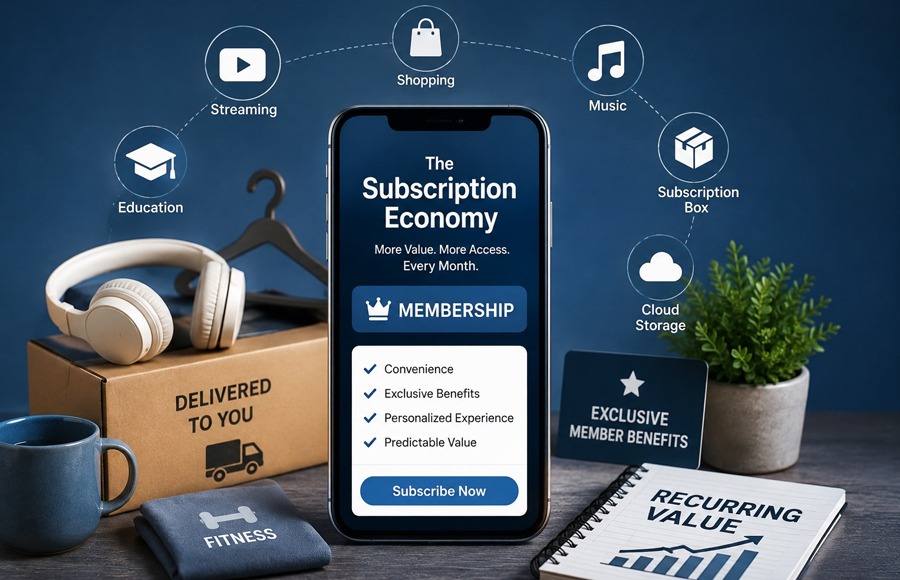

Over the past few years, the way consumers buy goods and services have changed dramatically. No longer satisfied with one-off transactions, consumers have favored subscription plans that give them continuing access to a variety of goods, services, content, and experiences. It has also given rise to what has termed as the, subscription economy the business ecosystem where companies earn recurring revenue via on going memberships and subscription plans.
Whether it’s for music streaming services, software programs, grocery delivery services, health and fitness content, an online course, or that trendy new outfit, this subscription model can be a part of various product and service sectors.
In exchange for the service, businesses get steady income and solid customer loyalty, whereas consumers appreciate a degree of convenience, the option for personalization, and on-going services.
What Is the Subscription Economy?
The subscription economy is a business model whereby customer pays a repeated price at a frequent interval-e.g., monthly, quarterly, and yearly to consume the service-product.
In most traditional businesses, reliance is solely upon the transaction. In a subscription business, there is strong emphasis on the on-going relationship with the customer.
Examples include:
- Streaming platforms
- Software subscriptions
- Online learning platforms
- Fitness memberships
- Meal and grocery subscriptions
- Beauty and lifestyle boxes
- Cloud storage services
- Premium shopping memberships
This model has become increasingly attractive because it creates recurring interactions between businesses and customers.
Why Consumers Prefer Membership Models
One of the main factors for the increase of subscription-based businesses is its convenience. Users sign up one time and they keep getting services without having to consider buying decision making repeatedly. For example, with streaming service subscriptions, consumers don’t have to purchase single movies and episodes to watch on a regular schedule.
Membership models can also provide additional benefits such as:
- Exclusive content
- Discounts
- Personalized recommendations
- Free or faster delivery
- Premium features
- Early access to products
- Members-only experiences
As consumers become more comfortable with digital payments and online services, recurring subscriptions have become easier to manage.
Predictable Recurring Revenue
For business, the advantage of the subscription model is that businesses can rely on predictable revenue streams.
The sales of the traditional business tend to be largely different from month to month. On the other hand, those companies which are following the subscription business model tend to grow their revenue at a normal pace since they charge the customers on a fixed schedule.
This helps businesses with:
- Financial planning
- Budget forecasting
- Investment decisions
- Product development
- Workforce planning
Recurring revenue can also make businesses more attractive to investors because it provides greater visibility into future income.
Customer Retention Becomes More Important
In the business of subscriptions, acquisition isn’t the only thing that matters. You’ve got to deliver enough value, consistently, so that subscribers stick with you.
This makes customer retention a central part of the business model.
Companies monitor factors such as:
- Customer satisfaction
- Subscription renewal rates
- Cancellation rates
- Usage frequency
- Customer lifetime value
- Engagement levels
If the customer is getting a sense of poor value, then they can discontinue their subscriptions. As such, companies have to go out of their way every so often, to go through an process of enhancing the products or experiences that they provide to the market.
Personalization Strengthens Memberships
Data and technology allow subscription companies to personalize customer experiences.
Businesses can analyze customer behaviour to understand:
- What products customers use
- How frequently they use them
- Which features they prefer
- What content they engage with
- When they are most active
It will then be used to present customised recommendations and offers to you.
For instance, a streaming platform could suggest show suggestions by your watching history and online store could recommend a product on past purchases.
Personalized Memberships Personalizing memberships will create more belonging for your members and boost member loyalty.
The Rise of Freemium Subscriptions
Freemium is a business strategy employed by a number of digital companies to entice clients to avail complimentary facilities while simultaneously investing in more costly provisions and extra features.
This approach removes the user’s barriers to adoption because they get to try out the service before spending money.
Once customers become familiar with the platform, some may upgrade for benefits such as:
- Additional storage
- Advanced tools
- Premium content
- Ad-free experiences
- Greater customization
- Enhanced customer support
Businesses can use the Freemium model to attract a substantial audience with the additional advantage of potentially converting its most enthusiastic and active users to paid clients.
Real-Life Example: Amazon Prime
Some of the best examples of a subscription business exist at Amazon.
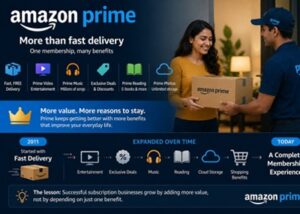
The subscription business at Amazon called Amazon Prime started out strictly as a shipping subscription where members pay an annual fee and get faster delivery on orders placed on the e-commerce giant. Now a large amount of extra features like entertainment, specific sales to Prime members, as well as other digital services and shopping features are available to those members.
This allows Amazon to further justify the perceived value of its subscription and keeps customers subscribed year after year, and the main lesson is successful subscriptions usually diversify its value proposition, as opposed to offering one service.
Real-Life Example: Netflix
Netflix shows how a business model can change an industry altogether Instead of asking consumers to buy or rent movies or television shows one-at-a-time, Netflix gives consumers access to a huge library on an on-going subscription basis. The company keeps investing heavily in original content, personalization, and technology and user experience to keep its subscribers satisfied. The company has proven how an on-demand model can successfully take the place of consumer ownership of entertainment.
Challenges of Subscription Businesses
However, despite the benefits of subscriptions, there are also several obstacles as well.
But there’s subscription fatigue, and consumers may wind up amassing too many memberships to be willing to continue them at some point and will start to unsubscribe services they don’t really need.
More businesses than ever must contend with competition as customers can easily evaluate subscription plans.
Other challenges include:
- High customer acquisition costs
- Subscription cancellations
- Continuous demand for new features
- Pricing pressure
- Customer service expectations
- Maintaining long-term engagement
Companies must therefore balance pricing, quality, and customer experience carefully.
How Businesses Can Build Successful Subscription Models
Businesses thinking about adopting a subscription model should concentrate on delivering on going value.
Important strategies include:
- Offer Clear Value: Customers should immediately understand why a subscription is worth paying for.
- Provide Flexible Plans: There are many ways that the different tiers can differentiate between customers with different budgets and needs.
- Improve Customer Experience: Straight-forward registration, intuitive payments, dependable service and hassle-free cancellation will help solidify trust.
- Keep Innovating: Regularly adding useful features, products, or content gives customers reasons to remain subscribed.
- Reduce Churn: Businesses also need to be aware of the reasons for cancellation and work on those issues prior to the loss of a customer.
The Future of the Subscription Economy
The subscription economy is still changing and business continues to experiment with new models for membership. With Artificial intelligence, companies may use machine learning to provide personalized experiences, anticipate and recognize a customer may want to cancel and form broader membership ecosystem that connect physical products and digital services. It will be a world of flexible and adjustable subscriptions, where customers pause, downgrade or upgrade plans anytime they desire and as often as they want.
Conclusion
Subscription has altered the nature of interaction between the companies and consumers. Now firms concentrate on everlasting relationships, providing continuous value, instead of one time transactions with customers. The possibility of planned revenue, personalized buying experiences, greater convenience and customer commitment result in member systems enticing in a diverse number of sectors.
However enduring achievement is dependent on stable and continuous offering of substantial value.
Sustaining customer and company relationships The businesses that concentrate on understanding what clients require, give flexible subscription choices, devote to innovation and retain consumers can efficiently make subscription models a useful long term resource of income. Considering how customer expectations keep modifying over time, subscription-driven companies will be part of the world commerce.
Tags
Related Posts




Sports
The Rise of Women’s Sports in India: From Participation to Prime-Time Audiences
For years, women’s sports in India existed in a strange space. The…

Finance
Emergency Funds Explained: How Much Money Should You Actually Keep Aside?
You never really know when an unexpected expense is going to show…

Travel
India’s New Weekend Economy: How Short Trips Are Changing Travel
What if you did not need a week-long holiday to feel like…