Business
India’s Manufacturing Renaissance: How Smart Factories Are Changing the Future of Business
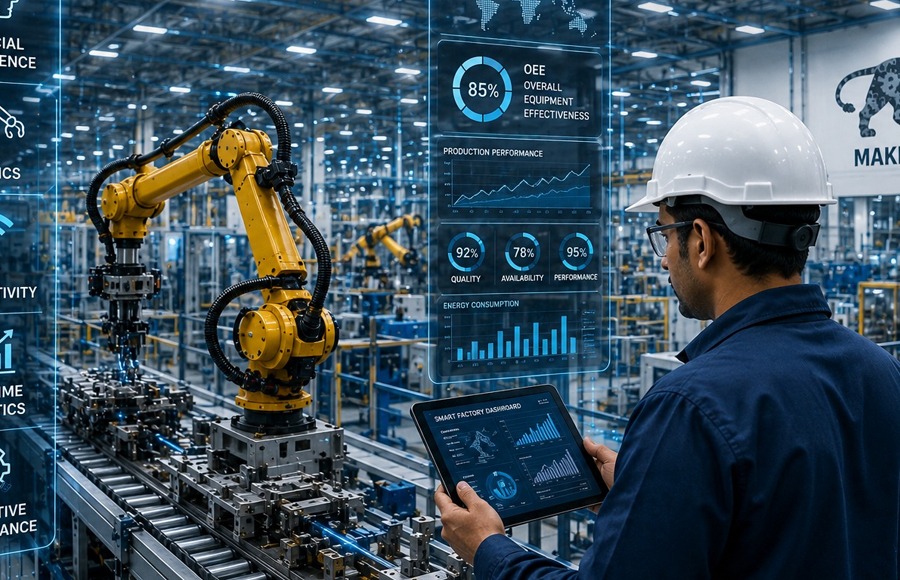

India is entering a new phase in manufacturing. For many decades, competiveness was driven by the labour base, scale of operation and high-end cost structure of production, but now technology is also part of it. Technologies like AI and robots, IIoT, digital twins, cloud computing and advanced analytics are making their way in into factories turning it into networked and intelligent places for production.
The opportune timing seems very pertinent, considering India’s economy grew at a 7.8% year on year growth rate in the April–June 2026 quarter whereas manufacturing growth registered 9.2% in the same quarter. The rise in private investment and capital are providing a favourable environment for companies to build and expand their capacity and technology base.
What Is a Smart Factory?
A smart factory is a manufacturing facility that uses digital technologies to link together machines, systems, people, and processes. Smart factories collect and analyse production data continuously as opposed to manual supervision and fixed production times.
Sensors monitor machines; AI detects deviations; robotic technology performs repetitious tasks; and a digital platform offers real-time monitoring of manufacturing operations to management.
The goal, however, is not just to remove the human worker and replace them with machinery. It is, rather, to bring about a manufacturing system which has technology to aid the human worker to reach decisions faster and more reliably.
AI Is Moving Onto the Factory Floor
The most significant technologies in modern manufacturing are AI. AI is capable of processing large numbers of production data and finding patterns which are not readily detectable by operators. For instance, predictive maintenance will likely soon become a feature that manufacturers incorporate into production, where sensors used to assess vibration, temperature, pressure and more will determine potential wear before machines actually fail.
AI-powered vision can assess components for flaws, which is particularly helpful in quality control such as the automotive, electronic, pharmaceutical and consumer products industries. More and more, Indian manufacturers have illustrated that to move beyond automation alone companies use AI, digital engineering and digital twins combined with predictive maintenance technologies.
Robotics Will Increase Manufacturing Productivity
Robotics also forms a substantial part of the smart factory transformation. These industrial robots are capable of undertaking monotonous, high precision or physically taxing work with uniform accuracy.
In the automotive industry, these robots can be deployed for tasks like welding, painting and assembly and in the electronics industry to help for precise manufacturing. Automated machines can also be employed for material movement, storage and sorting in ware-houses.
Cobots, collaborative robots are of special significance, as they work with humans instead of replacing them altogether. They can ease out some monotonous work and let the humans focus more on quality control, troubleshooting, supervision and tasks requiring more brains. This collaboration between human-machine interfaces can become crucial as Indian manufacturers eye higher productivity levels while retaining benefits of the existing labour expertise.
Digital Twins Can Change Business Decision-Making
The digital twin is one of the most promising new technologies for smart manufacturing. It is a virtual reproduction of a physical machine, production line or production process and can use real data on this information in a simulation to how the machine or process actually operates.
Manufacturers can use digital twins as a system to test changes. Business will therefore be able to estimate new plans, production plans, maintenance or machines used on a manufacturing process line before taking such a big risk operating such a plan.
This will allow many Indian companies to build highly flexible plants and have less relying on the past, and basing there decisions and plans more on real information.
Smart Factories Can Reduce Waste and Energy Costs
Manufacturing competence is no longer only defined by having increased quantity. In addition, it is crucial for enterprises to also optimize energy consumption, waste and pollution generated throughout the manufacturing process. Smart technologies help factories to monitor consumption of electricity, water, fuel, raw-materials as well as using AI models to detect areas for improvement within specific manufacturing processes.
This could mean the deployment of sensors that recognize when machines consume unexpected levels of energy. Furthermore, data about production processes and products could allow businesses to know where material is lost, where idle time is extensive or a particular part of the process is inefficient. As a result, environmental efficiency is becoming increasingly intertwined with economic value generation.
India’s MSMEs Have a Major Opportunity
Smart manufacturing is not solely restricted to the realm of large-scale firms, however. Indian small and medium enterprises, SMEs, of which there are millions in the nation, can slowly integrate Industry 4.0 technologies at their own pace and expense.
For instance, the small manufacturer does not necessarily have to develop the fully automated factory. The SME could start off with the installation of sensors in the vital machines, a digital inventory tracking system, cloud manufacturing monitoring or even an artificial intelligence-aided quality assurance process.
Government initiatives have even set up SAMARTH Udyog Bharat 4.0 and similar programs, aiming to bring awareness and adoption of these Industry 4.0 systems amongst the nation’s firms. There even exists demonstration and experiential centres to allow manufacturers experience these technologies first hand.
The Rise of Data-Driven Manufacturing
Possibly the largest transition will be from a production oriented business to a data oriented one. Many factories simply gather the data they need but do not optimize its use in the same way a smart factory does. Turning production data into intelligence; managers of a smart factory are able to determine operational health, including machine performance, production quantity, quality, inventories, energy consumption and supply-chain parameters through their digital interfaces. Such visibility allows manufacturers to adjust with changes in demand or supply disruptions rapidly, and also aid in forecasting and scheduling production.

Skills Will Become More Important
Technology by itself cannot build successful smart factories. Businesses will also require workers familiar with both manufacturing and digital technologies.
There may soon be increasing demand for engineers, technicians, and management personnel familiar with skills such as AI, data analytics, robotics, cyber security, automation and digital systems.
To that extent, reskilling your workforce is likely to become a top business issue. It will be incumbent upon an engineer to work comfortably both in the factory and with the network.
Challenges Businesses Must Consider
It is not without its difficulties also when smart manufacturing is introduced. Large upfront investment, cyber security concerns, older machines legacy equipment, lack of digital skills, difficulties integrating different systems can be bottlenecks on uptake. A company must therefore find some real use cases instead of using new technology merely for the reason that it is in style. A manufacturer needs to look for problems in operation and then match new technology to offer some value for itself.
The Future of Indian Manufacturing
Manufacturing in India is rapidly being driven by technology, investment and global competitiveness. Robust growth in recent manufacturing, increasing private capital investment and interest in advanced technologies will push factories into the centre of India’s new phase of economic progress.
Smart factories can enable Indian firms to achieve greater productivity, quality, flexibility and resource efficiency. Crucially, smart factories will contribute to enabling competitiveness within a global context where customers can no longer expect just speed of delivery but consistent speed along with full traceability and innovation at every step of production.
Therefore, the future of manufacturing in India will not be primarily about constructing more factories but rather enabling smarter ones where machines, people, data, and AI, collaborate together to boost competitive industrial economy.
Conclusion
Technology is transforming India’s manufacturing sector, spurring innovation, efficiency and competitive advantage. These sophisticated plants or ‘smart factories’ which integrate an advanced combination of robotics, IoT, automation, AI and digital twin technology, can offer manufacturers more quality, less wastage, better cost control, and more responsiveness to varying market conditions. Although the integration of these cutting edge processes call for investment, tech skilled labour and a well-developed security network, the prospect is too rewarding to disregard. In India too smart factories can, going forward enable companies to achieve a far greater operational agility, responsiveness and performance. And as Indian manufacturers – be it large or small companies-gradually move into Industry 4.0 territory, smart factories can play an instrumental role.
Tags
Related Posts




Health
Screen Time and Your Eyes: What Long Hours on Devices Can Really Do to Your Eyes
From checking emails and attending online meetings to scrolling through social media,…

Sports
How Sports Leagues Are Creating New Career Opportunities Beyond Athletes
Sports leagues are no longer defined solely by the athletes competing on…

Travel
How Railway Journeys Are Becoming Part of the Travel Experience Again
There was a time when a train journey was simply a way…