Business
The Rise of Quick Commerce: How 10-Minute Delivery Is Reshaping Retail Business
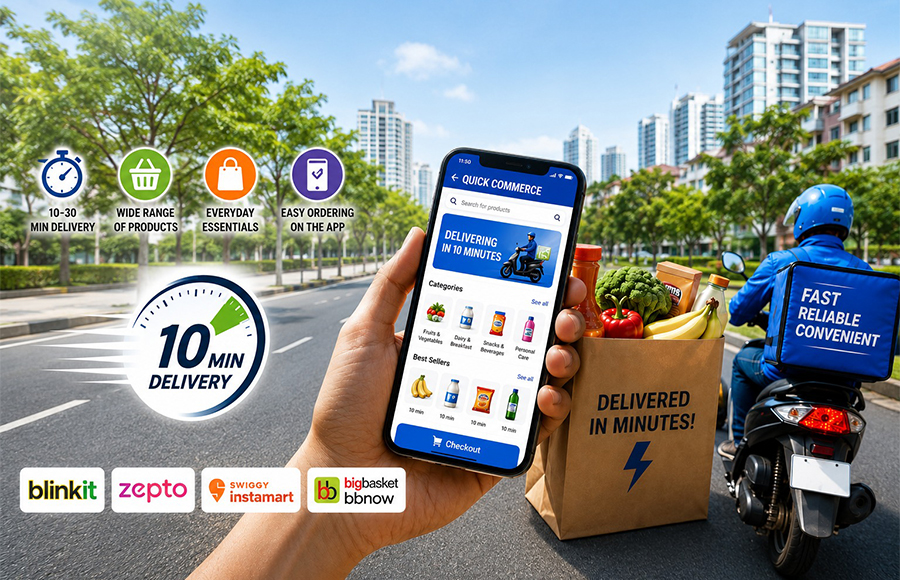

The last decade has seen a great evolution in the retail industry, consumer expectations have undergone a sea change, while technological advances have continued to redefine the market space at a rapid pace. Of the many innovations shaping recent times, quick commerce has gained immense traction. Its main idea centers on customer fulfilment, which means delivering orders to the consumer within minutes and not hours or days. Delivery times of 10- 30 minutes have redefined the shopping experience for groceries, daily necessities, personal care items and even electronics.
In India, Blinkit, Zepto, Swiggy with Instamart and Big Basket through BB Now have been at the forefront of bringing Q-commerce to Indian consumers. And while businesses worldwide continue to pump billions into the sector, driven by consumer demand for speed and convenience.
In this piece, we have delved into the nuances of how quick commerce works, and its appeal along with its impact on future retail.
What Is Quick Commerce?
Quick commerce is a model where customer orders are delivered in very fast speeds, typically 10-30 minutes. While normal e-commerce involves 1 or more days for delivery; quick commerce works with speedy order fulfilment on the premises of efficiently located warehouses, termed as dark stores.
Dark stores are not open to public customers, but function in such a manner to process and dispatch an order in minimal time. A mobile application is the medium through which a customer places the order; the warehouse’s employees pick and pack items with efficiency while a delivery executive fulfils the delivery to the customer’s address.
Why Consumers Prefer Quick Commerce
Busy work schedules, urban lifestyles, and unexpected daily needs have created strong demand for instant delivery services.
Quick commerce offers several advantages:
- Fast delivery within minutes
- Convenient mobile ordering
- Wide range of products
- Real-time order tracking
- Easy digital payments
- Reduced need for physical store visits
Instead of scheduling shopping excursions for the week, shoppers can acquire their day-to-day essentials when needed.
The level of ease has greatly impacted on purchase decisions made by shoppers.
The Technology Behind Quick Commerce
Technology is the backbone of successful quick commerce operations.
Companies use advanced systems for:
- Artificial intelligence demand forecasting
- Inventory management
- Route optimization
- Real-time order tracking
- Dynamic pricing
- Customer recommendations
AI assists us in anticipating where clients are going to shop based on an area.
This allows businesses to stock local warehouses efficiently and reduces delivery times
Furthermore, the technology boosts operation while cutting on delivery costs.
The Role of Dark Stores
Dark stores are one of the biggest innovations supporting quick commerce.
Unlike supermarkets, dark stores function solely as fulfilment centres.
Their close proximity to residential neighbourhoods makes it convenient for delivery executives to travel lesser distance.
Benefits of dark stores include:
- Faster order fulfilment
- Better inventory control
- Reduced operational delays
- Higher delivery efficiency
- Lower transportation costs
The localized warehouse strategy has also been implemented to the extent that it can now form the basis of almost all successful quick commerce businesses.
Changing Consumer Behavior
Quick commerce has fundamentally changed how consumers shop.
The days of collecting items to consolidate them before purchasing several can seem a bit prehistoric nowadays for many customers.
But they buy products as and when the need arises
For example, consumers frequently order:
- Groceries
- Fresh fruits and vegetables
- Dairy products
- Medicines (where permitted)
- Snacks and beverages
- Personal care items
- Household essentials
- Pet supplies
This shift has increased purchase frequency while reducing the average order planning cycle.
Retailers now interact with customers far more often than before.

Impact on Traditional Retail
The accelerating pace of quick commerce provides challenges and also opportunities to conventional retail players.
There are few stores, which have not faced increased competition from the home delivery option, now preferred by several customer sections for their comfort.
To remain competitive, traditional retailers are:
- Launching online ordering platforms
- Partnering with delivery services
- Improving digital experiences
- Offering click-and-collect options
- Investing in Omni channel retail strategies
Rather than replacing physical stores entirely, quick commerce is encouraging retailers to adopt hybrid business models.
Business Benefits of Quick Commerce
Quick commerce provides several advantages for retailers and investors.
These include:
- Increased customer loyalty
- Higher purchase frequency
- Improved customer convenience
- Better data collection
- Stronger competitive positioning
- Faster inventory movement
Your recurring customer interactions, by the same token, give your company good data on purchasing behavior you can use for personalizing marketing messages.
Companies can recommend products based on previous buying behavior, increasing customer lifetime value.
Challenges Facing Quick Commerce
Despite its rapid growth, quick commerce faces several operational challenges.
Major challenges include:
- High delivery costs
- Maintaining profitability
- Inventory management
- Delivery workforce availability
- Rising urban real estate costs
- Intense market competition
Many companies invest heavily in technology and logistics while operating on relatively thin margins.
Achieving long term profitability remains one of the industry’s biggest objectives.
But it all still comes down to keeping speed, customer service, and operational cost well balanced.
The Future of Quick Commerce
Quick commerce is expected to continue expanding as technology improves and consumer expectations evolve.
Future developments may include:
- AI-powered inventory optimization
- Autonomous delivery vehicles
- Drone deliveries in selected regions
- Hyper-personalized shopping experiences
- Sustainable delivery methods
- Expanded product categories
Businesses will begin to look to the operational side of things, but it is essential to provide the items very quickly.
The firms those are able to achieve a good combination of ease and efficiency, both for the user, as well for them themselves, will have a sustained period on top of the market.
Lessons for Businesses
The rise of quick commerce offers valuable lessons for businesses across industries.
- Put Customer Convenience First: In today’s market, consumers prize the values of speed, efficiency and reliability.
- Invest in Technology: AI, automation, and analytics enhance both operational performance and customer satisfaction.
- Build Efficient Supply Chains: Strong logistics networks enable businesses to deliver consistently.
- Use Customer Data Responsibly: Personalized recommendations can build customer loyalty and increase sales.
- Adapt to Changing Consumer Expectations: Businesses that evolve alongside customer behavior are more likely to remain competitive.
Conclusion
Quick commerce is an unstoppable retail trend revolutionizing how companies define convenience and how customer expectations of availability have changed. Powered by advanced technology, localized fulfilment centres and super-efficient supply chain processes, quick commerce has made 10-minute delivery a reality for thousands in numerous cities and towns throughout the US and across the globe.
Despite obstacles ranging from profitability challenges to steep operational costs, quick commerce has permanently altered the face of future commerce. The companies that embrace the innovation, build more robust supply chain structures and create an enhanced customer journey are the ones set up for success in this fast- paced landscape. As consumers push demand for speed and convenience ever further, look for quick commerce to become an indispensable feature of future retail.
Tags
Related Posts




Real Estate
The Next Phase of Rental Housing in India: How Institutional Landlords Could Change Urban Living by 2027
The market for rental housing in India is evolving and entering a…

Health
The Importance of Healthy Posture for Preventing Everyday Back and Neck Pain
Back and neck pain are common afflictions in today’s world. Sitting at…

Finance
How India’s Corporate Investment Revival Could Create New Opportunities for Investors
India is about to hit an important milestone; private companies are starting…