Travel
Slow Travel in India: Why Travellers Are Choosing Longer, Deeper Trips Over Packed Itineraries

There was a time when a good holiday in India came with a slightly ridiculous achievement list: three cities, seven forts, two waterfalls, one sunrise point and, if the itinerary allowed it, a café everyone on Instagram had already visited.
That style of travel is beginning to lose its shine. Indian travellers are increasingly asking a different question: What if we stayed longer and actually experienced the place?
The shift towards slow travel is showing up in booking behaviour, trip design and even the way younger travellers define a good holiday. Thrillophilia’s 2025 Multi-Day Travel Index, based on 210,112 travellers and 76,261 completed multi-day trips, found that travellers were increasingly choosing fewer destinations, longer stays and more realistic daily schedules.
And this is more than a niche preference. The latest official domestic tourism survey by India’s Ministry of Statistics and Programme Implementation found that around 80% of domestic overnight visitors stayed for five days or less, showing that the typical Indian trip is still relatively short. But within that window, the way people use their time is changing.
Want to know why Indian travellers are slowing down and what this means for the way we holiday? Read the full blog to discover the rise of slow travel in India.
From “How Much Can We See?” to “How Much Can We Experience?”
The clearest sign of the change is what travellers are removing from their itineraries.
According to Thrillophilia’s 2025 data, single-base trips with day excursions increased by 36% year-on-year, while itineraries covering four or more cities fell by 24%. Trips lasting six to nine nights grew 19%, while slower-paced itineraries increased 21%.
That tells an interesting story.
A traveller visiting Uttarakhand, for example, may once have tried to squeeze Mussoorie, Rishikesh, Auli, Chopta and Nainital into one holiday. The newer approach is more likely to pick one or two bases and explore around them.
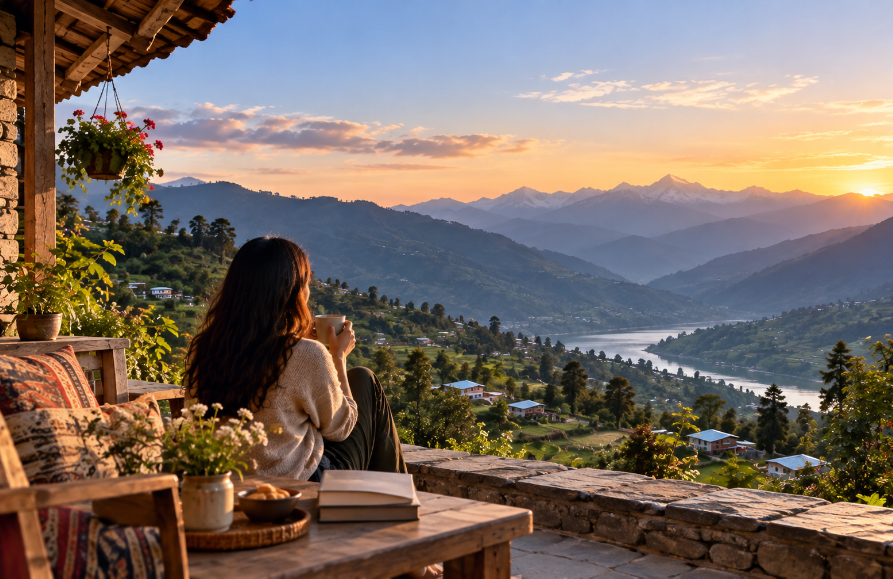
Instead of waking up, packing, checking out, driving for four hours and checking in again, the day can look like this: breakfast with a mountain view, a village walk, lunch at a local café, an afternoon doing absolutely nothing and an evening watching the sky change colour.
The destination stops being a backdrop between activities. It becomes an activity.
Longer Doesn’t Always Mean a Two-Week Holiday
Here is where the slow-travel trend gets interesting.
It would be misleading to say that every Indian traveller suddenly wants a 15-day sabbatical. Younger travellers, in particular, are travelling more frequently rather than necessarily travelling for longer.
Airbnb’s 2026 study of 2,012 Gen Z respondents across 11 Indian cities found that 70% preferred three short trips over one long annual holiday, while 87% preferred trips lasting under a week. Yet 64% deliberately leave parts of their itinerary unplanned.
So the real shift isn’t simply longer trips. It is less compressed trips.
A four-day holiday with one destination, two proper meals, a slow morning and plenty of wandering can be more “slow travel” than a ten-day itinerary involving six cities.
India’s travel calendar is therefore splitting into two parallel behaviours: more frequent short breaks and a growing appetite for longer, experience-led holidays.
The Stay Is Becoming Part of the Holiday

Another major change is happening inside the accommodation itself. Travellers are no longer treating their stay as just a place to sleep between sightseeing plans. Increasingly, the stay is becoming part of the experience.
This is where homestays come in. In Uttarakhand, platforms like GharOnGo are making it easier to discover local stays that offer more than a room: mountain views, home-cooked pahadi meals, village experiences and conversations with local hosts.
Instead of rushing out every morning to tick off another attraction, travellers can slow down, spend time at the property and experience the destination through the people who live there.
The idea is that sometimes, where you stay can be just as memorable as where you go.
The Anti-Checklist Traveller Is Here
Social media was once accused of making travel more performative: go somewhere beautiful, take the picture, post it, move on.
Now, ironically, social media may also be helping create the opposite behaviour.
Airbnb found that 90% of surveyed Indian Gen Z travellers actively seek places that haven’t gone viral or been widely recommended online. Nearly two-thirds intentionally leave parts of their schedules open, while nature and slow travel ranked as their top activity preferences.
That helps explain the growing appeal of lesser-known villages, local food trails, nature stays, regional festivals and experiences that cannot be completed in 20 minutes with a camera.
The bragging right is slowly shifting from “I went there” to “I actually experienced it.”
What Slow Travel Could Mean for India’s Next Holiday
Slow travel doesn’t mean abandoning sightseeing. It means changing the ratio. See the temple, but don’t rush away immediately. Visit the market, but leave enough time to eat there. Take the trek, but don’t turn the entire day into a race to the next viewpoint. Stay in one village for three nights instead of changing hotels every evening.
And perhaps most importantly, leave one afternoon completely blank.
India’s latest travel data suggests the holiday is becoming less about maximising destinations and more about maximising the quality of time spent in them.
The traveller who once returned home with 800 photographs may now return with three good conversations, a favourite local dish, a place they want to revisit and, wonderfully, an afternoon they did absolutely nothing with.
Maybe that is the real luxury of travel now. Not seeing more of India. Seeing more of the India you are already in.
Tags
Related Posts

Business
Why Indian Businesses Are Rethinking Customer Loyalty in the Age of Quick Commerce
For years, customer loyalty in India was built around familiarity. You went…

Sports
Beyond Cricket: How India’s Sporting Infrastructure Is Expanding Across Emerging Sports
For decades, India’s sporting identity was closely associated with cricket. But that…

Lifestyle
Why Your Sleep Schedule Matters More Than You Think: Understanding the Body Clock
You can sleep for eight hours and still wake up feeling exhausted.…