Finance
The Financial Lessons from India’s Stock Market Boom
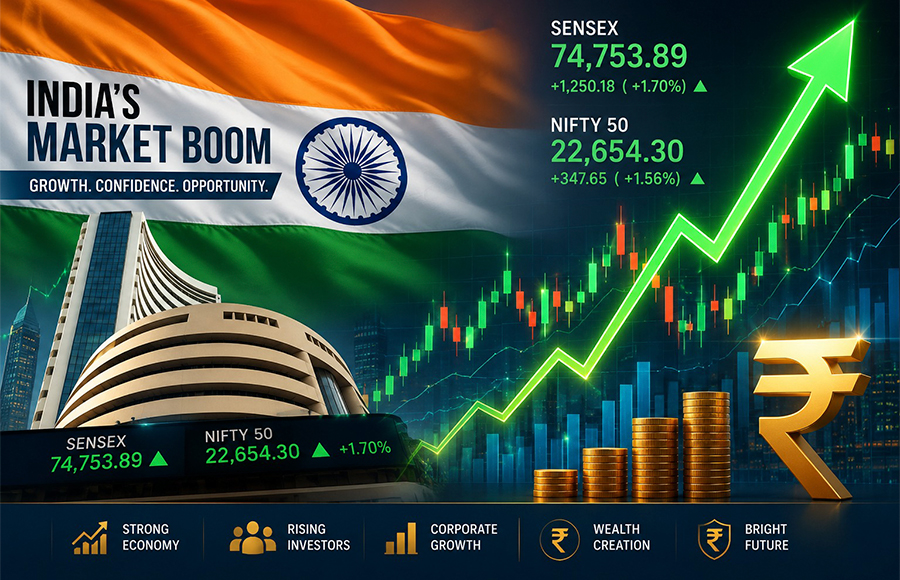

India’s stock market has witnessed remarkable growth over the past decade, transforming the country into one of the world’s most dynamic investment destinations. Major indices like the NIFTY 50 and BSE SENSEX have reached new highs, driven by economic expansion, rising corporate profits, digital investing platforms, and increasing retail participation. Millions of Indians who once relied solely on fixed deposits, gold, or real estate are now actively participating in equity markets.
India’s stock market boom offers powerful financial lessons for investors, whether they are beginners or experienced market participants. Understanding these lessons can help investors make smarter long-term financial decisions.
Understanding India’s Stock Market Boom
A stock market boom refers to a prolonged period during which stock prices rise significantly due to strong investor confidence and economic growth.
India’s market boom has been fueled by several factors:
- Strong GDP growth
- Digital transformation
- Rising retail investors
- Corporate earnings growth
- Increased foreign investments
- Government reforms
With the quick rise in the number of demat accounts and the rise of stock trading apps, entering the market has become easier than ever. These developments are also a sign of increasing optimism over India’s prospects.
The Power of Long Term Investing
Key lesson on stock market investment, to invest for long term. Quality stocks where the patient investor has spent 5-10 years would usually have ended up generating wealth for such individuals as markets would recover from shocks and the fundamental businesses would grow up compounding shareholders’ wealth.
This teaches an important principle:
- Time in the market is often more powerful than timing the market.
- Patient investors usually benefit more than those trying to predict daily price movements.
Compounding Creates Wealth
Compounding is one of the most powerful wealth-building concepts.
When investment returns generate additional returns over time, wealth can grow exponentially.
For example:
- Initial investment grows
- Returns are reinvested
- Future returns grow on both principal and profits
This creates a snowball effect.
The Indian stock market boom did pay dividends for those individuals who had been patiently investing through SIP, direct equity or mutual funds for long periods. Small regular amounts in SIP and direct equities can snowball over the period of time through systematic investment and compounding.
Retail Investors Are Becoming Powerful
One of the most remarkable changes in India’s stock market is the rise of retail investors.
Earlier, stock market participation was largely dominated by institutions and high-net-worth individuals.
Today, technology has changed this.
Thanks to:
- Mobile trading apps
- Online brokerages
- Easy demat account opening
- Financial education through digital media
These have paved the way for millions of investors to be part of the Indian markets. It is a positive sign that investing is now not a tool for the rich, but accessible to every Indian. Hence financial inclusion has grown considerably.
Knowledge Matters More Than Hype
A big lesson learned from market booms: Just being enthusiastic for stocks won’t pay the bills.
- Social media hype
- Tips from friends
- Market rumors
- Fear of missing out (FOMO)
This can be risky.
Successful investors focus on:
- Business fundamentals
- Revenue growth
- Profitability
- Debt levels
- Industry outlook
Research, don’t rely on instinct. People who invest from knowledge not emotion make more money.

Diversification Reduces Risk
Another key lesson is the importance of diversification.
Not all sectors perform well at the same time.
Some major sectors in India include:
- Banking
- IT
- Pharma
- FMCG
- Auto
- Energy
Some industries move higher than others when markets boom. But by investing in companies across multiple industries, investors avoid becoming overly exposed to one. This helps protect a portfolio when one industry is in a slump, keeping overall volatility lower.
Market Corrections Are Normal
Stock markets do not rise continuously.
Even during long bull runs, corrections and temporary crashes occur.
Reasons include:
- Global recessions
- Inflation concerns
- Interest rate hikes
- Geopolitical tensions
- Economic slowdowns
These drawdowns cause panic in many amateur investor portfolios But historically, corrections are a normal feature of investing. Many investors who take a long term view take advantage of drawdowns as entry points. One useful skill to have for investing is to be able to maintain calm during any sort of volatility.
Avoid Emotional Investing
Emotions strongly influence financial decisions.
The two biggest emotional challenges in investing are:
- Greed
- Fear
In bull runs, greed makes them to invest in highly speculative assets. In market crashes, fear makes the market panic sell. And the result is they erode long term returns.
The on going bull market run in India shows that if disciplined investing would more often work than to act emotionally to what’s currently news headlines.
This can lead the individual to make smarter financial choices. Ultimately, Emotional Management Skills are Crucial To Becoming wealthy!
SIP and Consistent Investing Work
Systematic investing has become highly popular in India.
Through SIPs (Systematic Investment Plans), investors contribute fixed amounts regularly into mutual funds.
Benefits include:
- Investment discipline
- Rupee-cost averaging
- Reduced timing risk
- Long term wealth creation
The Sip mode saves the investors from market vagaries, providing an equitable average at different times of market volatility. In India, an increasing trend is the rise in mutual fund penetration and discipline investment method has delivered great result. The more often regular disciplined investing proves more effective than a lump sum investment and then just praying or taking risk.
Economic Growth Drives Market Growth
Stock markets often reflect economic growth.
As India grows through:
- Infrastructure expansion
- Digital innovation
- Manufacturing growth
- Rising consumption
- Startup ecosystem development
Profit in the economy can rise; Profits are then higher in comparison; the result is better investment performance, and investors have learned to focus on macroeconomic developments. Long term Wealth can build wealth Investing in the growth economies is beneficial. India growth remains one of the key reason for market bullishness
Financial Lessons from India’s Market Boom
Investors can learn several powerful lessons:
- Invest for the Long Term: One big thing when it comes to equity investing is, Patience.
- Stay Disciplined: Stay away from hasty reactions in the market during volatile periods.
- Diversify Portfolio: Diversification cuts risk.
- Keep Learning: Good money know how will have led to better investment options.
- Control Emotions: Fear can harm returns
Conclusion
Indian share markets have a boomed since it can help to generate a huge wealth; consequently, all investors changed the habit. This phenomenon reflects how to make money through equity markets requires long term investing, Compounding, diversification, and financial discipline. Although share markets boomed to attract some exciting opportunity to make money, this also requires some patience, research, and emotional strength. As such, for all Indian investors, this is a clear indication. It requires staying vested in reliable and valuable securities and allows time and money to earn more, rather than hoping for a windfall gain in the short term.
Tags
Related Posts




Finance
What Is a Credit Score Really Made Of? Understanding the Factors That Affect Your CIBIL Score
What affects your CIBIL Score, and how can you improve it? CIBIL…

Business
The Rise of Micro-Entrepreneurship in India: How Small Creators Are Building Real Businesses
A creator with a phone, a niche audience and a good idea…

Real Estate
The Next Phase of Rental Housing in India: How Institutional Landlords Could Change Urban Living by 2027
The market for rental housing in India is evolving and entering a…