Real Estate
The Next Phase of Rental Housing in India: How Institutional Landlords Could Change Urban Living by 2027
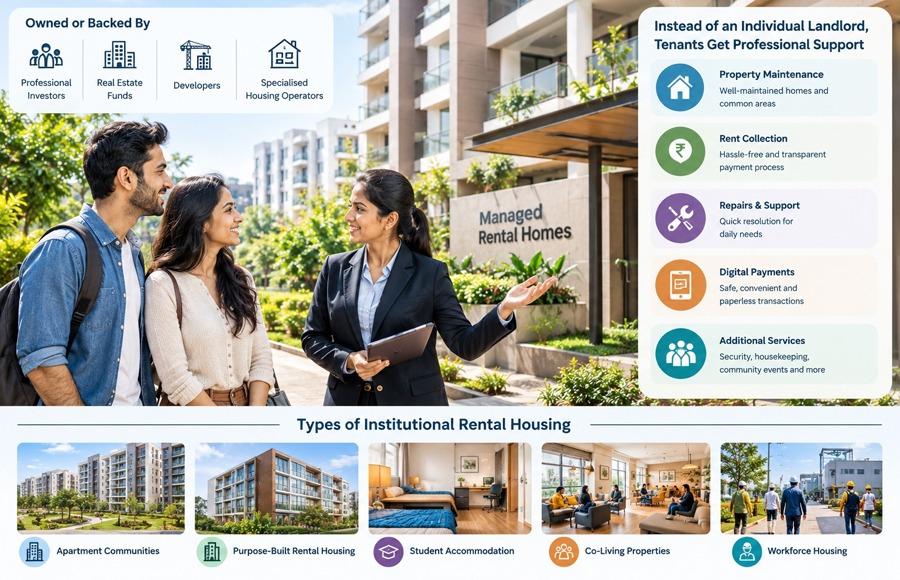

The market for rental housing in India is evolving and entering a new phase as urbanisation, working patterns and lifestyles change. For decades, rental housing in India has primarily been a market dominated by individual landlords with one or a handful of assets. Today, though, a professional, institutional owned and operated market is starting to gather momentum.
Over time to 2027, this move will slowly begin to de-seasonalise rentals, and a more systematic rental experience will emerge as professionally managed rental apartments, basic services, digital payments, repair and maintenance assistance and community facilities become a norm. Institutionalisation of rental housing is one of the emerging trends across the India Residential Market Outlook 2026 prepared by CBRE.
What Is Institutional Rental Housing?
Institutional rental housing refers to residential homes that are owned and,or managed by professional investors, real estate funds, developers or specialised housing operators. It’s important to note that tenants usually rent from a dedicated management company rather than a landlord or individual.
In practice, it can take the form of apartments, purpose-built rental homes, student housing, co-living and workforce housing. The key point is that the asset is run as a dedicated housing business rather than an individual investment property.
Why the Model Is Gaining Attention
India is also a highly dynamic labour market. Jobs have traditionally brought people to cities, and students constantly move between university towns and cities, while younger employees are looking for more flexible housing solutions near their work. The office market is also growing rapidly.
In Q2 2026, Indian companies lease approximately 24.6mn square ft. of office space – a new record according to CBRE, with demand from flexible work space operators, technology firms and GCCs contributing significantly to the total, especially in Bengaluru, Hyderabad and Pune.
These larger employment centres are thus likely to generate their own housing demands. This is good news for tenants, as it reduces some of the obstacles that can be found in traditional leasehold properties.
A More Professional Tenant Experience
Perhaps the most significant change is the tenant experience. Conventional letting experiences often require dealing with a myriad of different agents, landlords, maintenance men and service providers. The move to institutional investors could means residents will be able to access most of these services on one platform.
Digital portals could allow tenants to pay rent, book amenities and report repairs, while contact with a property management team could be streamlined to a single digital portal.
It could also help smooth the transition in and out of a property – crucial to building that all-important rapport with the mobile workforce or young professional renters.
Amenities Could Become Part of the Rental Product
This type of housing may also shape the expectations of tenants. Rather than simply renting an apartment, residents may expect to rent a whole living package with services and facilities such as gyms, lounges, co-working areas, games rooms, security, access to cleaning services and organised social events. This trend is being seen in niche offerings such as co-living and student housing. Amenities are a way to entice new residents and retain existing ones, but the costs of this extra provision can also raise operators’ costs, which must be balanced against affordable rents.
Technology Will Play a Bigger Role
Tech can be a pillar of professionally-managed rentals. Digital rent check-ins, online leases, automated rent collection, property-management software, smart access devices, resident-communication platforms-these and other innovations can help ensure professional property management.Artificial intelligence could eventually help operators monitor, predict and optimize maintenance needs, energy efficiency, occupancy levels and tenant needs and preferences. The Indian real estate sector is already becoming more data-driven on the whole, with CBRE pointing to increased use of AI tools to inform real estate decisions, not least the use of predictive leasing and operational tools. This trend could eventually find its way into rental housing.
Institutional Investment Could Bring More Capital
Growth of professionally managed rental housing could also open up a new asset class for institutional capital. According to the housing chapter in CBRE’s Indian real estate market outlook 2026, the industry is seeing a paradigm shift to institutionalised capital allocation, with investor participation in real estate coming through private equity, public equity, private debt and public debt. As the organised rental housing market matures, professionally managed residential real estate may become a more straightforward option for large investors to weigh up.
Even so, institutionalisation doesn’t necessarily mean a high growth rate for rental housing. CBRE has observed that dispersed ownership and regulatory oversights tend to slow institutionalisation.
Cities Beyond the Major Metros Could Benefit
Rental housing market may not be limited to Mumbai, Delhi-NCR, Bengaluru or Hyderabad. As more such opportunities open up in other cities, professionally-managed rental housing could come up near tech parks, industrial corridors, university towns and business districts.
Industrial workforce accommodation could be more focused on places where new manufacturing and logistics centres draw in employees from various places. This might enable developers to create rental housing options near employment hubs, and not just dependent on traditional residential sales.
Affordability Will Remain Critical
Pricing will be the biggest challenge. The operational costs of professionally managed communities and additional hospitality-like amenities may make institutional rental homes more expensive than unbranded, uncomplicated privately rented apartments.
For the model to scale up to serve a wider audience, it needs to cater to various end user segments through multiple pricing and service offerings. In the lowest tier, community housing can be offered at affordable rates, while a premium tier could include some added services. This is more crucial given the premium housing segment’s current run rate in India – CBRE research shows the high end accounted for approximately 27% of residential sales in 2025, overtaking the mid-end segment. Rental operators could tap into customers who want a better standard of living without buying a house.
What Could Change by 2027?
Institutional rental housing may step up to become another flavour of urban housing in India by 2027. While institutional players will not necessarily crowd out traditional landlord-occupied homes, they could at least add to the mix of options available to prospective tenants.
In addition to the institutional options, we may see the rise of specialised residential community options catering to various demographics such as students, young professionals, families, seniors and industrial workers. The various types of residential formats could be complemented by greater access to amenities and specialised services.
Residential development may be broadly trending toward a more organised segment. Our CBRE FY2027 outlook also described the Indian residential market as being still supported by fundamentals but headed toward a growth trajectory that is more sustainable.
Conclusion
The future of rental housing in India could be professional management, technology, specialised communities and institutional capital. Moving away from perceived landlord-tenant relationships, the market is gradually transitioning into a service provider with a structured rental housing offering.
By 2027, services in professionally managed rental communities could offer residents convenience, and forethoughts serviced homes while giving investors a potentially scalable residential asset class.
The success of this model will rely on getting the balance right – with quality and affordability. If operators are able to manage serviced homes for the Indian urban palate, rental housing can play a key role in Indian cities’ response to a mobile and changing workforce.
Tags
Related Posts




Health
The Importance of Healthy Posture for Preventing Everyday Back and Neck Pain
Back and neck pain are common afflictions in today’s world. Sitting at…

Finance
How India’s Corporate Investment Revival Could Create New Opportunities for Investors
India is about to hit an important milestone; private companies are starting…

Business
The Next Industrial Opportunity in India: Building Businesses Around Semiconductors, Space, Electronics and Solar
India’s industrial economy is entering a new phase. While traditional manufacturing remains…